Monday, January 31, 2011

Delta Report

For the first time in many years, I visited the blues country of the Mississippi Delta last week. I mean, I've driven through a couple of times in the past few years, but this was the first time I had spent more than a day there since about 1997. Even for a Southerner, the Delta is strange place, full of contradictions and mysteries.

The area that Mississippians call the Delta is the northwestern slice of the state, between the Mississippi and Yazoo Rivers, extending northwards to Memphis. It's flat - almost totally devoid of hills, with some of the deepest and richest topsoil in the country. There are places where it seems like you can see forever. The area was practically wilderness until the late 19th century, when planters bought large tracts and cleared them for cotton plantations. Cotton was a labor-intensive crop until mechanization changed the cotton industry in the 1940's, so large numbers of workers, mostly African-American, were recruited for cheap labor. The Delta's population was soon majority black, as it still is. The white minority resorted to increasingly oppressive tactics in order to maintain social and political control. It's no wonder that the Delta is often considered the birthplace of the blues.

On my trip, I stayed for two nights in Cleveland, in the very center of the Delta. I had wondered how this extremely poor region was faring during these economic hard times, and I must admit that Cleveland gave me a false impression. It appears to be a prosperous, bustling town; the downtown area is attractive and healthy. It only took a little driving around to other towns to discover that most of the area is not faring as well. Tutwiler, Glendora, Friars Point, Merigold - these towns are as shockingly poor as any places I have ever seen in the United States. Hirsberg's Drug Store in Friars Point has been around long enough for Robert Johnson to have played on the bench in front of the store, but it couldn't survive the current economic climate; they were having a going-out-of-business sale when I was there.

My wife made a little bit of fun of me because I visited so many dead blues guys' graves. But often those graves are the only remaining physical locations that represent those pioneers' careers - their homes are long gone, for the most part, as are the places they played. If you want to pay homage in the form of a blues pilgrimage, you're left with visiting graves. In some cases, you are left with visiting someone's guess about where a grave is. There are three Robert Johnson graves around Greenwood. And while I visited Charley Patton's grave in Holly Ridge, there are some who believe that he's buried in the nearby Longswitch cemetery. And one of Patton's relatives says that he's buried underneath the burner of the cotton gin next to the cemetery.
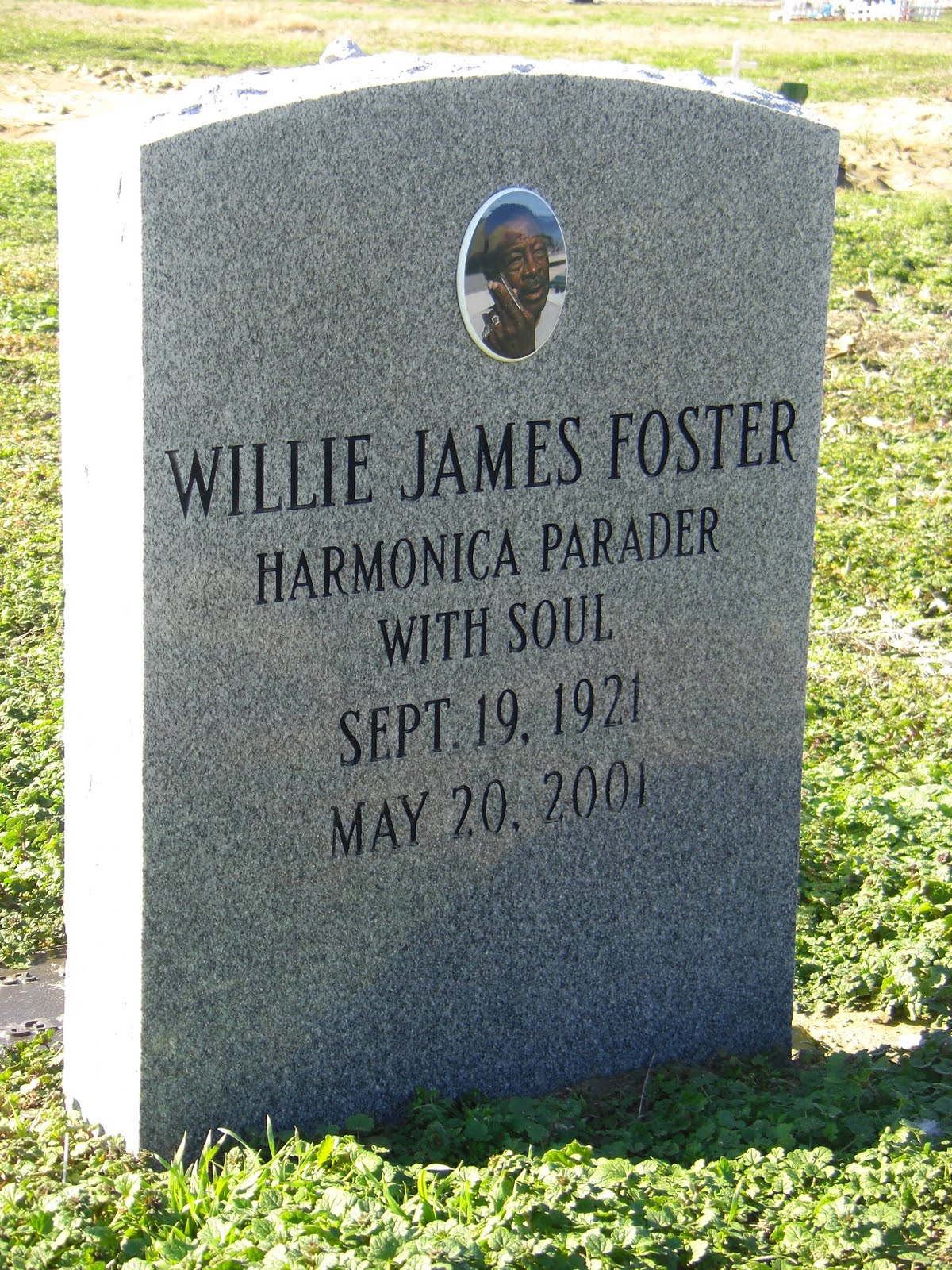

But the Holly Ridge cemetery is a place I always visit when I'm in the Delta. Although there are houses across the road and a working cotton gin next door, this spot somehow always gives me an intensely desolate, isolated feeling. I don't think I've ever seen another human being while visiting the cemetery, and it feels like the middle of nowhere as much as anyplace I've visited.

Digging a grave in the Holly Ridge cemetery must be a nightmare. I've never visited when the ground wasn't wet and spongy, with standing water scattered around. In addition to Patton, harmonica player Willie Foster (whom I heard in 1995) and Asie Payton, who had two stunning posthumous albums released, are buried there.

I also visited the grave of Sonny Boy Williamson (the second one) outside of Tutwiler, and Dockery Farms. Dockery, as much as any place on Earth, can reasonably lay claim to being the birthplace of the blues. Charley Patton lived there for some 30 years, and learned to play guitar there, inspired by an older musician, Henry Sloan.

But I wanted to hear some music, so after a couple of days I moved my base of operations to Clarksdale, where I rented a wonderful, large apartment downtown for a couple of days. I was staying two doors down from where W. C. Handy lived for awhile, and just steps from the depot where Muddy Waters caught the Illinois Central train to Chicago. Weekends are about the only time to hear music in the Delta, so on Friday night I went to hear Terry "Big T" Williams at Ground Zero, Morgan Freeman's blues club in Clarksdale. I had been impressed with Big T on recordings, but his live show was kind of disappointing - a pretty slick presentation of predictable blues covers by Albert King, B. B. King, etc.

But the next night was something else. Clarksdale once had numerous juke joints - informal bars with a jukebox and live music on the weekends. They're pretty much all gone now except for Red's. Red's frankly looks like an abandoned, boarded-up building. But on Friday and Saturday nights, it's anything but. The crowd was fairly small on the Saturday night I was there, but the music was just what I was looking for. Big A (I only learned his real name, Anthony Sherrod, later) and his three-piece blues band played with soul, humor, and intensity. They played some of the same cover tunes I had heard the night before, but Big A and his cheap-ass guitar (I never did figure out what brand it was) turned every song into a raw, strong, immediate experience. His rhythm section played with that perfect blend of drive and relaxation that's found in the best blues. I couldn't keep still.

There was more to my trip which would probably only interest someone as geeky as me. I loved the little moments when I encountered a trace or remnant of blues history, like the tile floor that's only thing left of Sonny Boy Williamson's house in Helena, Arkansas, or the trestle of the Yazoo Delta (Yellow Dog) rail line I unexpectedly came across in Boyle. A lot has changed in the Delta, but many things remain the same. I can't decide if that's good or bad.

Wednesday, December 8, 2010

Council Spur Blues - Robert Curtis Smith, RIP

I've been wanting to write something about the great, if obscure, bluesman Robert Curtis Smith. Now it seems as though this post must serve as a memorial. Smith was not famous enough for his passing to be noted in the press, but word has reached the blues community through his family that he died in Chicago in November. Smith deserves to be remembered by the world at large, if for no other reason than because he recorded one of the best blues albums of the LP era.

R.C. Smith was an elusive figure. He was born in or around Cruger, Mississippi, at the edge of the Delta region, around 1930. For the first 38 years or so of his life he seemed to alternate between attempting to survive the poverty and oppression of life in Mississippi and attempting to escape it. He left the Delta for Chicago and Texas at various times, but apparently found little relief, since he always returned to Mississippi. In an early-1960's interview with Paul Oliver, he described the conditions in which black sharecroppers found themselves in Mississippi:

You work from the time right sun-up until sundown. Other words in choppin' (cotton)
it's three dollars a day, and it's hard to make enough money to practically do anything, because, during the week you got to live and you go to the store and take up a little groceries to carry you that week but when you paid off you owe almost half of that. So there ain't anything you can do with the little change you has got, but stay here, because you can't leave here unless you do leave walkin'.

It would be nice to report that Smith's fortunes changed when he walked into Wade Walton's barbershop in Clarksdale on the day in 1960 when Paul Oliver and Chris Strachwitz were there, searching for unknown and long-lost blues musicians. Oliver and Strachwitz recognized his talent right away, and Smith made several recordings in 1960 and 1961, including one of the most remarkable blues albums ever. Clarksdale Blues: The Blues of Robert Curtis Smith was released on the Bluesville subsidiary of Prestige records; it made absolutely no impact and sunk without a trace, never to be reissued. But for those of us lucky enough to have a copy, it's a treasure.

Smith's music shows an awareness of the blues tradition; he "covers" songs by Memphis Minnie and Big Bill Broonzy, as well as the traditional "Catfish Blues." But the really striking songs are his originals. Their power comes largely from his melodic gift (not every bluesman can create memorable, beautiful melodies) and the structures of his songs - most are based on the standard 12-bar blues pattern, but are altered or extended in very interesting and original ways. One song, "Council Spur Blues," describes conditions on Roy Flowers' plantation in great detail, mentioning Flowers and his overseer, Mr. Walker, by name. This was a brave gesture for a black man in Mississippi in 1961.

Smith finally escaped Mississippi around 1968, spending the rest of his life in Chicago. He played the blues up north for awhile, and even auditioned for a spot in Willie Dixon's band. At some point, he had the religious conversion experience he later recounted in "Lye Water Conversion" on the album From Mississippi to Chicago, and only performed gospel music after that. Most people in the blues community knew nothing of all this for years; it seemed as if this talented musician had just disappeared from the face of the earth. For a long time Jim O'Neal, owner of the Rooster Blues record label, had a picture of Smith posted in his Stackhouse record store in Clarksdale; the caption read, "Do you know this man?"

Eventually Wade Walton became aware of Smith's whereabouts; this led to his appearance at the 1997 Sunflower River Blues Festival in Clarksdale, where I was lucky enough to hear him. It was clear that this was Smith's first performance ever in a concert setting; he was uncomfortable and unsure of what to do or say on stage. But the music (all gospel songs, of course) was passionate and powerful, and over all too soon.

And now there won't be any more music by this remarkable musician. But you can still hear his recordings, if you can find them. A comprehensive discography of Smith's records has been put together by Stefan Wirz, and can be found here. It looks like a lot of records, but most of the issues are drawn from the same few recording sessions. The most easily available CD featuring Smith is I Have to Paint My Face: Mississippi Blues 1960, an anthology on the Arhoolie label; Smith's four solo selections are excellent, and there's a fun example of Wade Walton's infectious, rhythmic playing of his razor and strop to Smith's guitar accompaniment. From Mississippi to Chicago, mentioned above, features several of Smith's later gospel songs and is still in print. Clarksdale Blues, his masterpiece, is long out of print and very difficult to find, but for those who know their way around the internet, can be found for download.

I'm glad I got to hear R.C. Smith perform that afternoon in Clarksdale. So long to a talented man who overcame a lot.

Saturday, December 4, 2010

Revisiting Ma and Fletcher

(I apologize in advance for the appearance/layout of this post. I tried to insert the photos in such a way that would look good on the screen, but found that I have very little control over how it may end up looking on any individual computer screen. On the plus side, you can click on any photo for a larger view.)


Yesterday I headed south again, armed with a camera this time, to revisit the Ma Rainey house and grave that I stumbled on by chance last month. (See my November 10 post.) The door of the Rainey house was locked when I tried it, but the woman working there had seen me walk up, so she let me in after determining that I was there to visit the museum, not for any nefarious purpose. She obviously had been trained in Rainey lore, but in some way she didn't seem to "get" it - a lot of the things she said were close to being right, not not quite. I would have preferred to be left alone to wander around by myself, but that didn't seem to be an option.


The house, as pictures attest, was in pretty bad shape a few years back, but it's been restored nicely. Much of Ma's original furniture is intact, including the piano, which has been stripped of the green paint that someone applied at some point. There are some Paramount records on display that made me drool. Otherwise, the displays were pretty generic, providing information about Rainey and the blues. But for me, the whole point was just being in Ma Rainey's house.

One of my assumption in my previous Rainey post was wrong, I think. Ma had such a large house built not so that she could take in boarders, but so that her parents (and sister, I think) could live with her. I was fascinated to see that she had her father's name inscribed in the concrete before the door.


I was also wrong in assuming that the Pridgetts buried on either side of Ma Rainey in Porterdale Cemetery were sisters. Edna, her mother, is on one side, and I think that (based on the dates) that Edna's sister is buried on the other side.


While in the cemetery I took also took pictures of an interesting-shaped tombstone, and the stone marking the grave of Jenny, Kizzie's baby, that I wrote about in that earlier post. Notice that Jenny's stone is marble, and professionally carved. Many, if not most, of the monuments in Porterdale cemetery are concrete, and are much rougher (and cheaper) in appearance. Who paid for the the stone over Jenny's grave? Was Kizzie the maid of a privileged daughter? Could Jenny's father have been the slavemaster?


After paying my respects at Porterdale, I headed 60 miles further south, to the little town of Cuthbert, Georgia. Cuthbert was the birthplace of the great Fletcher Henderson, who practically invented the big band swing style. Henderson spent most of his life in New York or on the road, but he's buried in his hometown. While Ma Rainey was buried in a segregated cemetery, Henderson's grave is in the town's main, mostly white, graveyard. I don't think this had anything to do with his fame as a musician; it was probably due to the respect in which his father was held. Fletcher Henderson, Sr. was principal of the African-American school in Cuthbert for decades.


I last visited Cuthbert and Fletcher's grave about 15 years ago. At that time, there was nothing at the gravesite to indicate that a brilliant and widely influential musician was buried there. Since that time, Chet Kruly, who played with Henderson's band in the late 1940's, sponsored a marker which at least mentions that Henderson had a band.


I'm glad I got to pay my respects to these two great Georgia musicians.

Friday, November 26, 2010

Audio Glimpses of the Past

I spend a good bit of time in antique stores these days, searching for 78s. A couple of months ago, I visited an Atlanta antique store which had an interesting-looking box. It looked like it might have records in it, and it did - not 78s, but 40 or 50 home-recorded discs. They were 12" discs; some were marked as 33 1/3, and some were labeled with song titles or rudimentary information about the radio programs they were recorded from. I bought three of the most promising-looking of the records, took them home, and found them to be easily playable on my turntable. Moreover, they were quite well-recorded, for the most part. A couple of the sides were pretty disappointing - they proved to be nothing more than recordings of disc jockeys playing records, but several of the sides were intriguing and musically rewarding enough to get me pretty excited.

Radio was once a more interesting and creative medium than it is these days. Bands of all types commonly broadcast live from clubs and ballrooms, their sounds carried over the various radio networks to listeners across the country. These broadcasts were sometimes recorded by hobbyists with home recording equipment, which until the late 1940's meant a disc recorder of some kind. The person who recorded the stash of discs I found labeled some with his name, and even with information about the equipment he used.

Our recordist was named J.M. Keith, apparently from Atlanta, since most of the radio stations he recorded from were Atlanta stations like WSB and WAGA. On a couple of discs he engraved the make, model, and serial number of the recorders he used. The earlier records were made with a Presto Model Y, serial #4111. The Model Y paired one of Presto's cheaper recorders with an amplifier and speaker. Later, Mr. Keith upgraded to a Presto 6N, serial #1891. The 6N was a high-quality machine, used by many radio stations. And it wasn't cheap. The price for 6N was $735 in 1950; it probably wasn't much less in 1948, when Keith seemed to have acquired his.

Our friend J.M. Keith had somewhat eclectic tastes; he recorded all kinds of music. There's a really horrible "lounge" quartet from a club in New York, several disc jockey shows, and lots of recordings from the semi-classical Bell Telephone Hour. Listening to those first three discs and examining the labels and sleeves gave me some insight into Mr. Keith's labeling system, though, so I went back to the antique store and bought all of the records that I though might contain worthwhile music. I ended up with a dozen discs. They all seem to be have been recorded in 1947 or 1948. I played them all one evening, one after another, and it was like a trip back in time - like listening to a couple of hours of late-forties radio, dialing to different stations every twelve minutes or so. Most of the discs are quite well-recorded, although in a few cases, the surfaces have deteriorated a little bit. And Mr. Keith would occasionally record with the gain set too high, resulting in some distortion.


There ended up being six sides of music that were interesting enough to digitize and preserve:

Three tunes by the Ray McKinley big band from the Roosevelt Hotel in New Orleans, August, 1947. One of these is Eddie Sauter's amazingly forward-looking "Sand Storm," which the band had recorded in the studio a year and a half earlier.

Three selections by a very different big band, that of Noro Morales. "Caramba Bebop" from this broadcast is a very hot piece of Latin jazz, with an oddly wonderful piano solo by Morales.

A broadcast by the Adrian Rollini Trio. Rollini was the first great bass saxophonist in jazz, but by 1947 he was playing vibes and doubling on chimes. These are the only hot jazz chimes solos I've ever heard.

A side split between Rollini's trio and the Mary Osborne Trio. Osborne was an excellent Charlie Christian-inspired guitarist, but she's featured mostly as a vocalist here.

Twelve or so minutes from an August, 1948 broadcast of the Grand Ole Opry. This is an interesting broadcast, but I was surprised at how lame most of the music was. The other side of this disc is much better:

Part of the WSB Barn Dance program that followed the Grand Ole Opry. Barn Dance was similar to the Opry, but the music (and comedy) is more "down home."

I have uploaded selections from all of these broadcasts (except the Grand Ole Opry) here. Once on the page with the links, you can click to listen or right-click to download. I hope you enjoy these audio glimpses of the past. And thank you, J.M. Keith.

Wednesday, November 17, 2010

Blues Poetry II

As I was cleaning out my file cabinet a few days ago, I came upon a folder of transcriptions of blues lyrics that I did about 15 years ago. Once again, I was stuck with what beautiful poetry blues lyrics can be. Here are four of my favorites from that old stash of transcriptions, plus one more (the Percy Mayfield song) that I transcribed tonight.

Transcribing blues lyrics can be a challenge. Thick Mississippi accents, idiosyncratic pronunciation, archaic turns of phrase, poor recordings with worn surfaces - all of these conspire against an accurate hearing of the lyrics. Comparing different published transcriptions of the same song might reveal very different hearings. But I reviewed all of these tonight, and I'm satisfied with their accuracy. Being Southern helps, as does experience with listening to the blues.

And as wonderful as some of these lyrics are, they are greatly enhanced by hearing them in context, sung by these brilliant musicians. The interaction of the lyrics, the singing, and the instruments is what creates the complete picture. I've listed the original issue, place and date of recording after each song. Punctuation and line breaks are, of course, my own.

Mama, “Tain’t Long for Day
Blind Willie McTell

Wake up, mama, don’t you sleep so hard.
Boy, it’s these old blues walkin’ all over your yard.

I’ve got these blues, reason I’m not satisfied.
I’ve got these blues; I’m not satisfied.
That’s the reason why I stole away and cried.

Blues grabbed me at midnight, didn’t turn me loose ‘til day.
I didn’t have no mama to drive these blues away.

The big star fallin’, mama, it ain’t long for day.
The big star fallin’, mama, ‘tain’t long for day.
Maybe the sunshine will drive these blues away.

(Oh, come here quick.
Come on mama,
You know I gotcha.)

Mm – mm.
Mm – mm.
Mm – mm.

Victor 21474
Atlanta, Georgia; October 18, 1927


Son House is one of my favorite bluesmen, and one who really paid attention to the quality of his lyrics. "Pony Blues" is traditionally about sexual prowess; House's version seems to be about more than that. Everyone will have his or her own interpretation, but to me, House's pony is himself - his soul.

The Pony Blues
Son House

Why don’t you catch my pony; now saddle up my black mare.
Oh, my pony; saddle up, up my black mare.
You know I’m gonna find my baby, well, in the world somewhere.

You know, he’s a travelin’ horse, and he’s too black bad.
He’s a travelin’ pony; I declare, he’s too black bad.
You know he got a gait, now, no Shetland ain’t, ain’t never had.

You know, I take him by the reins and I led him around and round.
I said I take him by the reins and I, I led him around and round.
You know, he ain’t the best in the world, but he’s the best ever been in this town.

You know, he’s a travelin’ horse and he don’t deny his name.
He’s a travelin’ pony and he don’t deny his name.
You know, the way he can travel is a lowdown, oh, dirty shame.

Why don’t you come up here, pony; now come on, please, let’s us go.
I said, come up, get up now; please, pony, now let’s us go.
Let’s we saddle on down on the Gulf of, of Mexico.

You know, the horse that I’m riding, he can foxtrot, he can lope and pace.
I said the pony I’m ridin’, he can foxtrot, he can lope and pace.
You know, a horse with that many gaits, you know, I’m bound to win that race.

Mm, he’s a travelin’ horse and he don’t deny his name.
He’s a travelin’ pony; he don’t deny his name.
You know, the way he can travel is a lowdown, oh, dirty shame.

Library of Congress 92401
Robinsonville, Mississippi; July 17, 1942


Sad Days, Lonely Nights
Junior Kimbrough

My mama told me –
I was a child.
She said, “Son,
Gonna have hard days.”

My daddy told me, too.
He said, “Son,
Gonna have sad days,
Lonely nights;

Sittin’ alone;
Head hung down,
Tears runnin’ down.”


Done got old –
Sad days,
Lonely nights
Done overtaken me.

Sometimes I sit alone;
I wonder ‘bout the things
My mama and daddy told me.

Sad days,
Lonely nights
Done overtaken me.

Fat Possum 1006
Holly Springs, Mississippi; April, 1994


Memory Pain

Percy Mayfield

Every time I see a woman, it makes me think about mine.
Every time I see a woman, it make me think of mine.
And the way she used to treat me, boys, I just can’t keep from cryin’.

I used to come home in the evenin’; that woman would be gone.
When I would come home in the evenin’, my woman would be gone.
And when I would get up in the mornin’, boys, she’d just be coming home.

I don’t see well, and I’m absent-minded,
And I hardly sleep at all.
My past has put me on a habit
Of nicotine and alcohol.
It serve me right to suffer; serve me right to be alone.
Seems I’m still livin’ with the memory of the days that’s past and gone.

Specialty 2126
Hollywood, California; April 23, 1952


This Joe Callicott song was later recorded by Ry Cooder as "France Chance." Callicott's reference to "great news" means "big news," not "good news."

Love Me Baby Blues
Joe Callicott

Drop down, baby, just like showers of rain;
Hate to hear my fair brown call my name.
Yeah, I hate to hear my fair brown call my name;
Well, she calls so loud and the poor girl calls so plain.

Walked to the station, tears runnin’ down;
I got news my baby done left town.
Yeah, I got news my baby, well, she done blowed this town.
Well, I got great news – my baby done blowed this town.

Rooster crowed in England; heard ‘im in France.
Look like the other guy won’t ‘low me no chance.
Yeah, look like the mmm…, ah, they won’t ‘low me no chance.
Ah, look like to me I can’t get a possible chance.

I knows my doggie when I hear him bark;
I know my baby if I feel her in the dark.
Yeah, I know my baby… I feel her in the….

Ah, tell me woman, how can you be so mean?
Give all of my money out on the brand new stream.
Baby, oh tell me, woman, how can you be so…?

Arhoolie 1042
Nesbit, Mississippi; August, 1967

Wednesday, November 10, 2010

A Chance Encounter With Ma Rainey

I'll begin this post as so many bloggers have over the years: It's been a long time since my last post. I'll try not to let that happen again. Now, on to business:

Yesterday I drove the 90 miles or so from Atlanta to Columbus, Georgia to hunt for 78s and do some geocaching. Columbus in a nice little city; the downtown area is pretty healthy, mostly due to the large number of Columbus State University students spending their money, I imagine. After looking around downtown for awhile, I drove down 5th Avenue and was surprised to see a historical marker proclaiming "Ma Rainey Home."

Ma Rainey was one of the seminal blues performers and recording artists, although "seminal" seems like an odd adjective to apply to a woman. She was born Gertrude Pridgett in Columbus in 1886 - earlier, notice, than either Charley Patton or Blind Lemon Jefferson. She was singing the blues on tours throughout the South by the time she was 20, and was one of the first Southern blues singers to record - although Bessie Smith beat her to the studios by ten months. Rainey recorded 111 released sides (including alternate takes); unfortunately, her entire recording career was for Paramount Records, famous for the poor quality of their recordings and pressings. But enough of her voice comes through the lousy sound to make it clear that she was the real deal - a strong, earthy singer who sounds like she grew up with the blues.

I had forgotten that this great woman was from Columbus. By the time my brain had processed what I had just seen, I had passed the house. I quickly backed up, pulled over and got out of the car. I read the marker several times, and stared at the house for awhile. It's a large house - I suspect Rainey rented out rooms - and it's painted yellow, as it apparently was when Rainey lived there between her retirement in 1935 and death in 1939. The house is now a museum, but I didn't know that - there was nothing to indicate that it was open to the public. So I just stared.

The marker indicated that Porterdale Cemetery, where Rainey is buried, was nearby. I found the cemetery about a half mile away. Three guys were digging a grave near the entrance, so I pulled over and asked where Ma Rainey's grave was, and one of them showed me. Rainey is buried between two of her Pridgett sisters; each has a concrete slab over her grave. Ma's just reads "Gertrude Rainey" and the date of her death, but she also has a nice new headstone proclaiming her status as "Mother of the Blues."

After visiting the grave, I had the urge to drive back by the house while playing some Ma Rainey music. This was all unplanned, so I didn't have any Rainey CDs with me, but I had brought Allen Lowe's idiosyncratic blues history box set Really the Blues? as road music, so I found "Don't Fish in My Sea" and cranked it up.

It was very cool to run across Rainey's house more or less by chance, and to be led to her gravesite by the plaque. I'm planning to go back before too long, actually visit the museum and take some pictures.

At the cemetery, I had a gut-wrenching moment not directly related to Ma Rainey. Porterdale Cemetery was a burying ground for the black residents of Columbus - for most of the South's history, segregation didn't end with death. Near Rainey's grave was the grave of an infant. The headstone was inscribed with the child's given name (which I don't remember), the date of her death (1858) and "Kizzie's Baby." No last names. I thought it was odd, until it hit me - Kizzie and her child didn't have last names. They were slaves. You can't live down here without frequently thinking about the terrible history of the region, but it was a powerful experience to unexpectedly come across the raw evidence of human slavery - not in a museum, not in a book, but while just wandering around.

Saturday, September 4, 2010

So Long, Donna's

Music has been a part of life on New Orleans' Rampart Street at least since the beginnings of jazz. On South Rampart one could hear Bunk Johnson and Sidney Bechet playing at the Eagle Saloon or young Louis Armstrong holding forth at the Red Onion. (Both of these buildings are still standing.) The ballroom of the Astoria Hotel was a popular spot in the 1920s and 30s; you could catch Lee Collins and David Jones with their Astoria Hot Eight. Heading downtown to North Rampart, Luis Russell led the band at the Cadillac before moving north to Chicago. The Boswell Sisters were "discovered" while singing at the New Orleans Athletic Club. Cosimo Matassa opened his first recording studio at the corner of North Rampart and Dumaine, the corner immortalized in Professor Longhair's "Go To the Mardi Gras." In the 1970s, Lu & Charlie's featured Ellis Marsalis, Alvin Batiste, and James Booker. More recently, Big Sam Williams' Funky Butt was one of the best places in the city to hear music, but the club never reopened after Katrina hit. And now an era has ended: a couple of weeks ago Donna's, the last music club on North Rampart, closed its doors for the last time.

Music clubs come and go all the time; none of them last forever - although it looks like the Village Vanguard has a shot at immortality. So why does the closing of Donna's affect me so much?

From the time that it opened in the early 1990s (I don't remember the exact year), Donna's was something special. Even to an introvert like me, who mostly just wants to be left alone, Donna's was warm and welcoming. It's kind of a cliche, but you felt like family as soon as you walked in the door.

And, of course, the music was often amazing. In the early days, Donna featured brass bands; there weren't really any other clubs featuring this amazing New Orleans hybrid music at the time. The bands would stand at one end of the room, and if you wanted to use the restroom, you had to walk through the band. The first time I heard a New Orleans brass band in the flesh was in Jackson Square, where the young Rebirth Brass Band was playing for tips, but my second exposure to this incredible sound was at Donna's, where I heard the Algiers Brass Band. It was such a stunning experience that I went back a couple of nights later to hear the Pin Stripe BB. I was also fortunate enough to catch Tuba Fats' Chosen Few, the Mahogany, Treme, Hurricane (from Holland), and Hot 8 Brass Bands there.

Later, of course, they built a bandstand against the windows facing Rampart. And expanding from brass bands, Donna booked a variety of New Orleans music (mostly jazz) into the club.

Memories from Donna's:

The Tom McDermott Quartet had just played a version of "Blues My Naughty Sweetie Gave to Me" which took all sorts of unexpected and unusual turns. I remember one passage in which drummer Shannon Powell was playing in a different, but related, tempo than the rest of the group. As they played the last note, a police car zoomed down North Rampart, sirens blaring. Bassist Matt Perrine laughed and said, "Oh, no - the trad police!"

Uncle Lionel Batiste coming into the club, dressed as sharp as a tack, and dancing with all the young ladies to whatever band was playing.

Speaking of Mr. Batiste - standing near him as the Treme Brass Band was playing and realizing just how interesting and creative his bass drumming is.

Hearing Kermit Ruffins and the Barbecue Swingers' dark, spooky version of "Light Up." One young man took the message of the song to heart and lit up a joint in the middle of the floor. Donna, who was sensitive to illegal shenanigans in her club, came over the bar like some sort of action hero and had the guy out the door in seconds.

The sitters-in: you never knew who was going to show up to play - Leroy Jones, Nicholas Payton, David Torkanowsky, Kermit, visiting musicians from Europe or Japan. One night Tom McDermott was playing with the young band Loose Marbles when veteran trumpeter Jack Fine came in and sat at the bar. He stayed there all night with his horn on the bar, and whenever he felt like it, he'd pick up the trumpet and join in from his barstool.

And on a couple of occasions, Donna's was where I experienced some of the best music I have ever heard in my life. I can think of at least two evenings when Evan Christopher and Tom McDermott, playing either with a quartet or as a duo, "lifted the bandstand," as Thelonious Monk put it - they played music that transcended "good music" and touched another level.

Donna's husband Charlie manned the kitchen. I still think his barbecue ribs were the best I ever had.

Donna and Charlie decided to close the club for a variety of reasons. Charlie has had health problems, and Donna has been commuting to and from Florida, where she has a teaching job. But the primary reason seems to be the condition of the building; the landlord has been unwilling to make repairs, and the building has been slowly falling apart. Incidentally, this was one of the reasons for the demise of the Funky Butt - and that building was owned by the same landlord.

I don't live in New Orleans; I was a couple-of-times-a-year visitor to Donna's. I doubt anyone associated with the club would remember me. But I owe some of my most cherished memories to that little club on the corner of North Rampart and St. Ann. So long, Donna's - I'll miss you.